
medicine nobel prize 2025
- Three scientists’ discovery of immune system peacekeepers earns the 2025 Nobel Prize in Medicine, a breakthrough reshaping how we fight autoimmune diseases, cancer, and more.
- A Shared Honour
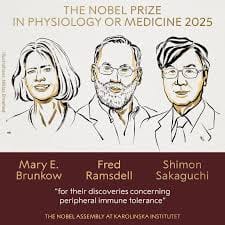
- The Nobel Assembly declared that Brunkow, Ramsdell, and Sakaguchi are the recipients of 11 million Swedish kronor in total (roughly $1.2 million) to be shared amongst them.
- In the course of a press conference after the award ceremony, Sakaguchi shared, “The mystery of how the immune system, a design for our protection, was always turning against us has been the reason why I considered it only my life’s work to try to understand that paradox.”
- They have not only had a lot of scientific knowledge as their glasses were clearer, but they have also brought a lot of hope to millions of patients who suffer from autoimmune diseases all over the world.
Shimon Sakaguchi paved the way in 1995 when he challenged the prevailing view that immune tolerance was solely maintained by eliminating harmful immune cells in the thymus, a process called central tolerance. His research showed the immune system was more complex, identifying an entirely new type of immune cell—regulatory T cells—that shield the body from autoimmune disorders.
In 2001, Mary Brunkow and Fred Ramsdell advanced this field through genetic research. While studying a mouse strain prone to autoimmune disease, they discovered a mutation in a gene they named Foxp3.
This mutation disabled the immune system’s regulatory controls, leading to severe illness. Crucially, they confirmed that mutations in the human equivalent of Foxp3 cause a rare but serious autoimmune condition known as IPEX syndrome.
Two years later, Sakaguchi connected the dots, proving that the Foxp3 gene orchestrates the development of the regulatory T cells he had identified earlier. These cells act as immune monitors, ensuring that defensive responses target genuine threats while tolerating the body’s own tissues.
medicine nobel prize 2025
“Their discoveries have been decisive for our understanding of why we do not all develop serious autoimmune diseases,” said Olle Kämpe, chair of the Nobel Committee.
Beyond transforming immunology, these findings have opened new frontiers for medical treatments. The concept of peripheral tolerance now underpins emerging therapies for autoimmune diseases, cancer, and organ transplantation. Several Foxp3-based therapies are already in clinical trials, with hopes of improving patient outcomes and enabling more successful transplants.
medicine nobel prize 2025
The 2025 Nobel Prize in Medicine celebrates three scientists whose collaborative breakthroughs have reshaped the fight against immune-related illnesses, offering hope for millions affected by autoimmune and inflammatory diseases worldwide.
- What have the three winners done?
- The human body has a powerful and complex immune system, which not just fights off various bacteria and viruses, but also knows what cells should not be attacked.
- According to the Nobel Prize’s official press release, “Mary Brunkow, Fred Ramsdell and Shimon Sakaguchi are awarded the Nobel Prize in Physiology or Medicine 2025 for their fundamental discoveries relating to peripheral immune tolerance. The laureates identified the immune system’s security guards, regulatory T cells, which prevent immune cells from attacking our own body.”
- First, the basics of the immune system
- The human body’s immune system fights off thousands of microbes attempting to invade our bodies every day. Microbes vary wildly, and many even have ‘camouflages’ that mirror human cells. Thus the immune system must distinguish what to attack and what to tolerate.
medicine nobel prize 2025
Shimon Sakaguchi’s key insight
In the mid-1990s, Shimon Sakaguchi challenged conventional belief by postulating that some specialised T cells act as “security guards” of the immune system, suppressing overly aggressive responses.
In a series of experiments, he examined mice whose thymus had been removed and matured T cells injected into their bodies later. He identified a class of T cells that basically ask other T cells, which might be attacking the body’s own tissues, to calm down. These are called regulatory T cells.
medicine nobel prize 2025
Brunkow, Ramsdell, and the FOXP3 gene
Far away from Sakaguchi, Brunkow and Ramsdell were examining sick male mice, and through painstaking elimination and identification of genes, had managed to find that the particular mutation making these mice sick was related to a rare autoimmune disease among humans, called IPEX. Both the diseases were caused by mutations in the FOXP3 gene.
Finally, in another few years, it was established that FOXP3 gene controls the development of regulatory T cells, whose existence Sakaguchi had earlier established. It is this composite work done over decades that has won the Nobel.
medicine nobel prize 2025