
The Church of Jesus Christ of Latter-day Saints
The “Mormon Church,” officially known as The Church of Jesus Christ of Latter-day Saints, is a restorationist Christian denomination founded by Joseph Smith in 1830. It is the largest group in the Latter Day Saint movement and believes Joseph Smith was a prophet who restored the original church established by Jesus Christ. The Church of Jesus Christ of Latter-day Saints
Its key beliefs include the divinity of Jesus Christ, the restoration of his church, the Book of Mormon as a companion to the Bible, and eternal families through temple ordinances.
Founder and history: The church was founded on April 6, 1830, in Fayette, New York, by Joseph Smith.
It faced significant opposition, leading to migrations to Ohio, Illinois, and eventually to Utah under the leadership of Brigham Young after Smith’s assassination.
Core beliefs:
Jesus Christ: Jesus is the Savior and the Son of God, and his atonement makes salvation possible.
Restoration: Members believe that after the apostles died, the church lost its authority and doctrines, which have been restored through Joseph Smith.
Scriptures: In addition to the Bible, Latter-day Saints also use the Book of Mormon, the Doctrine and Covenants, and the Pearl of Great Price as scripture.
Modern prophets:
The church believes that modern prophets receive revelation from God, and it is guided by leaders including a prophet and apostles.
Practices:
Missionary work: A cornerstone of the faith is sharing the gospel through missionary work.
Tithing:
Members are taught to pay a 10% tithe of their income.
Health code: The Word of Wisdom is a health code that prohibits alcohol, coffee, tea, and tobacco.
The Church of Jesus Christ of Latter-day Saints
The Church of Jesus Christ of Latter-day Saints
The Church of Jesus Christ of Latter-day Saints
Family focus: The theology places a strong emphasis on families, with temple rituals intended to unite them eternally.
History
- Founding: The church was founded by Joseph Smith on April 6, 1830, in Fayette, New York.
- Migration and Persecution: Smith’s followers, often called “Mormons,” migrated westward to escape persecution. After Smith was murdered by a mob in 1844, Brigham Young led the majority of members to the Utah Territory.
- Succession: After Smith’s death, several groups split off from the main church, though the Utah-based LDS Church is the largest by far. One prominent offshoot is the Community of Christ (formerly the Reorganized Church of Jesus Christ of Latter Day Saints).
The Church of Jesus Christ of Latter-day Saints
The Church of Jesus Christ of Latter-day Saints
The Church of Jesus Christ of Latter-day Saints
- Family: The church teaches that families can be eternal through sacred temple ceremonies known as “sealings”. Members hold weekly “Family Home Evenings” for bonding and spiritual instruction.
- Missionary Work: The church maintains a large, global missionary program. Young members often volunteer for full-time missions to proselytize and perform humanitarian service.
- Strict Health Code: Adherents follow the “Word of Wisdom,” a health code that forbids alcohol, tobacco, coffee, and tea.
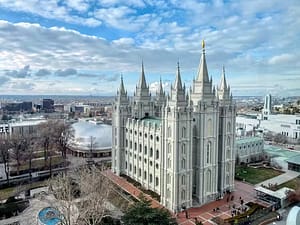
- Temples: Distinct from regular meetinghouses, temples are sacred buildings where members participate in special ceremonies and make covenants with God, such as “endowment” and “sealing”.
- Polygamy: Though practiced in the 19th century, the LDS Church officially discontinued polygamy in 1890 and now excommunicates members who practice it.
The Church of Jesus Christ of Latter-day Saints
The Church of Jesus Christ of Latter-day Saints
The Church of Jesus Christ of Latter-day Saints
- In addition to its core beliefs and practices, The Church of Jesus Christ of Latter-day Saints has a structured organizational hierarchy, a global missionary program, and temples worldwide for sacred ceremonies.
- Organizational structure
- The Church’s organization is led by a prophet and a council of apostles, with local-level congregations led by bishops and stake presidents.
- The First Presidency: The highest governing body consists of the Church President, who is considered a modern-day prophet, and his two counselors. Following the death of a president, the longest-tenured apostle becomes the next Church President.
- Quorum of the Twelve Apostles: The second-highest governing body is a council of 12 men who act as special witnesses of Jesus Christ and serve under the direction of the First Presidency.
- General Authority Seventies: These leaders assist the Quorum of the Twelve Apostles in administering Church affairs and preaching the gospel throughout the world.
- Auxiliary Organizations: The Church has global organizations for women (Relief Society), children (Primary), young men (Young Men), and young women (Young Women).
- Local Leadership: At the local level, a congregation (known as a ward) is led by a bishop, while a group of wards (a stake) is led by a stake president. These are unpaid volunteer positions.
- Missionary program
- A distinguishing feature of the Church is its extensive missionary program, which uses a New Testament model of missionaries serving in pairs.
- Service: Young men (starting at age 18) typically serve for two years, and young women (starting at age 19) serve for 18 months. Older couples can also serve missions.
- Funding: Missionaries are volunteers and fund their own missions, often with help from family or their local congregation.
- Activities: The missionaries spend their time proselytizing, teaching lessons about the gospel, and providing community service.
The Church of Jesus Christ of Latter-day Saints
The Church of Jesus Christ of Latter-day Saints
The Church of Jesus Christ of Latter-day Saints
- Temples and sacred ordinances
- Latter-day Saints believe that sacred ceremonies, or ordinances, can be performed in temples to create eternal covenants with God.
- Sealing: The most prominent temple ordinance is the sealing, which can unite a husband and wife, and their children, for eternity. This differs from the traditional wedding vow, “till death do us part”.
- Baptism for the Dead: Temple work also includes performing proxy ordinances for deceased ancestors, who can then choose whether to accept them.
- Family History: Family history, or genealogy, is a central practice that enables temple work for ancestors. The Church sponsors FamilySearch, a non-profit genealogy organization with the largest collection of family records in the world, available free to the public.
The Church of Jesus Christ of Latter-day Saints
The Church of Jesus Christ of Latter-day Saints
The Church of Jesus Christ of Latter-day Saints
- Differences from mainstream Christianity
- The Church of Jesus Christ of Latter-day Saints considers itself a restored form of primitive Christianity but differs significantly from traditional Christian denominations.
- Godhead: Latter-day Saints view the Godhead as three distinct beings—God the Father, Jesus Christ, and the Holy Ghost—who are one in purpose, rather than a single essence as defined by the Nicene Creed.
- Scripture: While believing in the Bible, the Church uses an open scriptural canon that includes the Book of Mormon, Doctrine and Covenants, and Pearl of Great Price.
- Exaltation: The Church teaches that faithful members can progress to become like God in the afterlife, a process known as exaltation. This differs from the mainstream Christian view of salvation.
- Restoration: The Church maintains that the original Christian church and its authority were lost through apostasy and that it was restored through Joseph Smith.
The Church of Jesus Christ of Latter-day Saints
The Church of Jesus Christ of Latter-day Saints
The Church of Jesus Christ of Latter-day Saints
- Social and political stances
- The Church holds a position of political neutrality but has taken stances on issues it regards as moral concerns.
- Family: Emphasizes the importance of the nuclear family and heterosexual marriage, as detailed in “The Family: A Proclamation to the World”.
- LGBTQ+ Issues: Has taken a conservative stance on LGBTQ+ issues, including opposition to same-sex marriage.
- Immigration: Supports compassionate immigration policies while also recognizing a nation’s right to secure its borders.
- Abortion: Opposes elective abortion but acknowledges it may be an acceptable option in certain cases, such as rape, incest, or when the mother’s life or health is at risk.
- Political Leanings: Many members in the U.S. lean conservative and Republican, though the Church does not endorse a specific party or candidate.
The Church of Jesus Christ of Latter-day Saints
The Church of Jesus Christ of Latter-day Saints
The Church of Jesus Christ of Latter-day Saints